
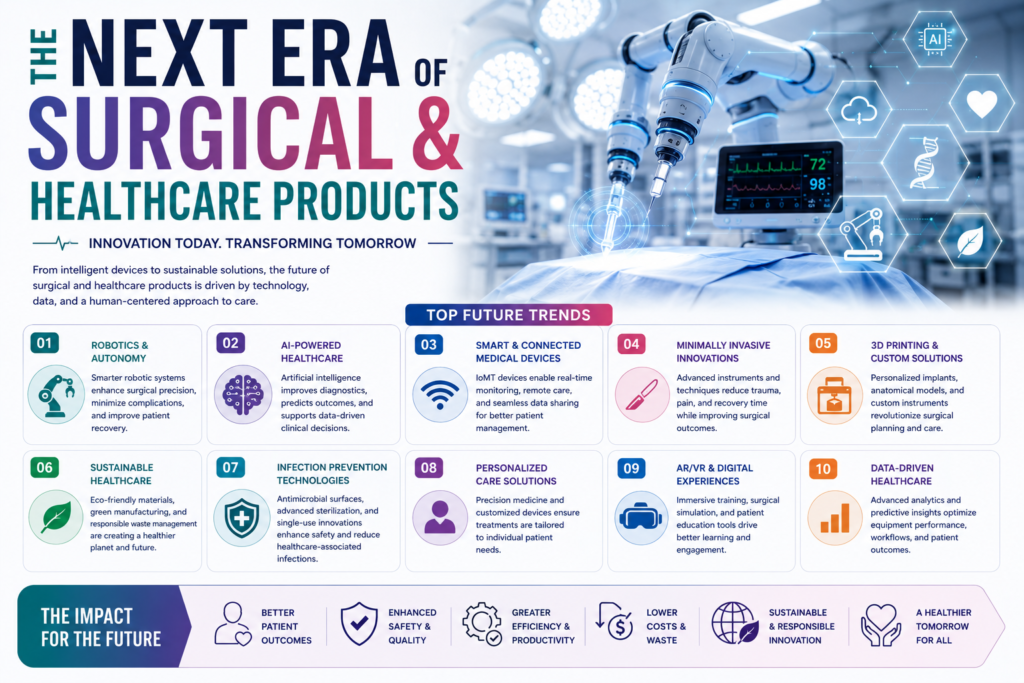
The healthcare industry is undergoing a period of rapid transformation driven by technological innovation, evolving patient expectations, and the growing demand for high-quality medical care. Surgical and healthcare products are at the center of this evolution, helping healthcare professionals deliver safer, more efficient, and more personalized treatments. From smart medical devices to sustainable product designs, the future of healthcare products promises to improve patient outcomes while reshaping the way medical services are delivered.
As hospitals, clinics, and healthcare providers prepare for the next generation of medical advancements, understanding emerging trends in surgical and healthcare products becomes increasingly important. These innovations are expected to enhance clinical performance, improve operational efficiency, and support the future of patient-centered care.
The Rise of Smart Medical Devices
One of the most significant trends shaping the future of healthcare is the development of smart medical devices. These products incorporate sensors, wireless connectivity, and data analytics capabilities to provide real-time information to healthcare professionals.
Smart monitoring systems can continuously track patient vital signs, detect abnormalities, and transmit data directly to healthcare providers. This allows for earlier intervention and more proactive patient management. In surgical settings, intelligent devices can help monitor procedural conditions and support more accurate decision-making.
As healthcare facilities increasingly adopt digital technologies, smart medical devices are expected to become standard components of modern patient care.
Artificial Intelligence in Healthcare Products
Artificial Intelligence (AI) is rapidly becoming an important part of healthcare innovation. Future surgical and healthcare products are likely to incorporate AI-powered features that assist with diagnosis, treatment planning, and clinical decision-making.
AI can analyze large volumes of patient data, identify patterns, and provide insights that may not be immediately visible to healthcare professionals. In surgical environments, AI-assisted systems may help improve procedural precision, optimize workflows, and enhance patient safety.
As machine learning technologies continue to advance, healthcare products will become increasingly intelligent and capable of supporting more personalized care strategies.
Growth of Minimally Invasive Technologies
Minimally invasive procedures have already transformed many areas of medicine, and this trend is expected to continue in the future. Healthcare providers increasingly prefer products that reduce patient trauma, shorten hospital stays, and accelerate recovery.
Advanced catheters, guide wires, endoscopic instruments, and specialized surgical devices are enabling physicians to perform complex procedures through smaller incisions. Future innovations will likely focus on improving device flexibility, precision, and ease of use.
Patients benefit from reduced pain, fewer complications, and faster returns to daily activities, making minimally invasive technology a major driver of healthcare advancement.
Robotics in Surgical Procedures
Robotic-assisted surgery has become one of the most exciting developments in modern medicine. Future surgical products will continue to integrate robotic technologies that enhance precision, control, and visualization during procedures.
Robotic systems allow surgeons to perform delicate operations with greater accuracy and stability than traditional techniques. Continued improvements in robotics may lead to more accessible and cost-effective solutions for hospitals worldwide.
As robotic technology becomes more sophisticated, it has the potential to transform a wide range of surgical specialties, including cardiology, urology, gynecology, and general surgery.
Personalized Healthcare Products
The future of healthcare is increasingly focused on personalized treatment approaches. Rather than relying solely on standardized solutions, healthcare providers are moving toward products designed to meet individual patient needs.
Personalized medical devices may be developed based on patient anatomy, medical history, and treatment requirements. Customized implants, patient-specific surgical planning tools, and individualized treatment technologies are expected to become more common.
This approach can improve treatment effectiveness while enhancing patient satisfaction and long-term outcomes.
Advancements in Biocompatible Materials
Material science is playing a major role in the development of next-generation healthcare products. Future surgical instruments and medical devices will increasingly utilize advanced biocompatible materials that improve safety, durability, and performance.
Innovative materials can reduce inflammation, support healing, and minimize the risk of adverse reactions. In addition, improvements in material engineering may lead to lighter, stronger, and more flexible devices that enhance both patient comfort and clinical efficiency.
These advancements will help manufacturers create products capable of meeting increasingly complex healthcare demands.
Expansion of Remote Patient Monitoring
Remote healthcare solutions have gained significant attention in recent years, and their importance is expected to continue growing. Future healthcare products will increasingly support remote patient monitoring and virtual care delivery.
Wearable devices, wireless sensors, and connected monitoring systems allow healthcare professionals to track patient health outside traditional clinical settings. These technologies help identify potential issues earlier and reduce unnecessary hospital visits.
Remote monitoring products are particularly valuable for managing chronic conditions, postoperative recovery, and elderly patient care, making them an important component of future healthcare systems.
Sustainable and Environmentally Friendly Products
Sustainability is becoming a priority across many industries, including healthcare. Manufacturers are exploring ways to reduce environmental impact while maintaining high standards of safety and performance.
Future healthcare products may incorporate recyclable materials, eco-friendly packaging, and more sustainable manufacturing processes. Hospitals are also increasingly interested in balancing infection control requirements with environmental responsibility.
The healthcare sector’s commitment to sustainability is expected to drive innovation in product design, waste reduction, and resource management.
Enhanced Infection Prevention Technologies
Infection prevention will remain a critical focus in healthcare product development. Future innovations are likely to include antimicrobial materials, advanced sterilization technologies, and improved protective equipment.
Healthcare providers continuously seek solutions that reduce the risk of healthcare-associated infections and improve patient safety. New technologies may provide additional layers of protection while supporting more efficient infection-control practices.
As patient safety standards continue to evolve, infection prevention innovations will remain a key area of investment and research.
Digital Integration and Connected Healthcare
Healthcare products are becoming increasingly connected through digital ecosystems that enable seamless communication between devices, healthcare professionals, and hospital systems.
Future surgical and healthcare products may automatically collect, analyze, and share patient data in real time. This connectivity supports better clinical coordination, improved decision-making, and enhanced patient management.
Connected healthcare environments can help reduce administrative burdens, improve efficiency, and provide more comprehensive patient care throughout the treatment journey.
The Growing Importance of Patient-Centered Design
Modern healthcare increasingly emphasizes the patient experience. Future products will likely focus on improving comfort, usability, and accessibility while maintaining clinical effectiveness.
Manufacturers are designing devices that are easier to use, less intimidating, and more comfortable for patients. Whether in hospitals, clinics, or home-care environments, patient-centered products can improve treatment adherence and overall satisfaction.
By prioritizing patient needs, healthcare organizations can create more positive healthcare experiences and support better long-term outcomes.
Conclusion
The future of surgical and healthcare products is being shaped by technological innovation, digital transformation, and a growing commitment to patient-centered care. Trends such as smart medical devices, artificial intelligence, robotic-assisted surgery, personalized treatments, remote monitoring, sustainable product development, and advanced infection prevention technologies are transforming the healthcare landscape. These innovations have the potential to improve clinical outcomes, enhance efficiency, and make healthcare more accessible and effective for patients worldwide. As the industry continues to evolve, healthcare providers who embrace these emerging trends will be better equipped to meet the challenges and opportunities of modern medicine while delivering exceptional patient care.